
Breast Lift with Implants in São Paulo: Lifting the Breasts with Silicone Implants
Breast lift with implants is the plastic surgery that, in a single procedure, corrects sagging of the breasts (breast ptosis) and places the silicone implant. In other words: in the same surgery, the excess skin is removed, the breast is repositioned on the chest and the implant is inserted to restore volume and fullness to the upper pole. It is the classic indication for the patient who has sagging or “deflated” breasts — after pregnancy, breastfeeding, weight loss or due to the natural aging of the tissues — and who also wants to increase or restore volume.
When the patient only lacks volume, without sagging, the indicated surgery is breast augmentation (implant alone). When there is sagging without a desire for more volume, a breast lift without implants is indicated. Breast lift with implants solves both problems at once.
At the practice of Dr. Marco Longo — plastic surgeon in São Paulo, CRM-SP 122.172, RQE 58.398, Full Member of the Brazilian Society of Plastic Surgery (SBCP), Doctorate (PhD) from USP and fellowships at NYU and Memorial Sloan-Kettering Cancer Center (New York) — this surgery is performed with his own technique, the “Push-Up” Breast Lift with Implants, described in detail further down this page.
Who is a candidate for breast lift with implants?
Breast lift with implants is usually indicated for patients who have:
- Breast sagging (ptosis) — the breast has “dropped” on the chest and the nipple is at or below the level of the inframammary fold;
- Loss of upper pole volume — the cleavage has become empty, with a “deflated” or emptied-out look;
- Changes after pregnancy and breastfeeding — the most frequent combination of volume loss with excess skin;
- Sagging after significant weight loss, including post-bariatric and after treatment with GLP-1 analogues;
- Asymmetries of volume and position between the breasts;
- Patients who already have implants and have developed breast sagging over time, requiring repositioning combined with implant exchange;
- Pseudoptosis — a situation in which the nipple is well positioned, but the breast tissue has slipped down below it.
The indication, the type of technique and the size of the implant are never defined by photo or by message: they depend on the in-person evaluation of the breast measurements, the quality and thickness of the tissues, the degree of ptosis and the individual goals of each patient.
Where is the implant placed? Understanding the surgical planes
The choice of plane — exactly where the implant is positioned in relation to the pectoral muscle — is one of the most important technical decisions of the surgery and changes the final shape of the breast. There are two classic planes.
Subglandular or subfascial plane (implant in front of the muscle)
In this plane, the implant sits between the mammary gland and the pectoral muscle — in the subglandular plane, directly under the gland; in the subfascial plane, under the fascia that covers the muscle, which adds a thin layer of coverage.
Advantages
- A more visible implant with a more defined shape — indicated for those who want a fuller, more defined upper pole;
- A higher, more medialized décolleté (fuller cleavage, with the breasts more “together”);
- No dynamic deformity: the implant does not move when the patient contracts the pectoral muscle;
- A usually more comfortable recovery, since there is no muscle dissection.
Limitations
- Less soft tissue coverage over the implant, which can make the edges more noticeable in very thin patients;
- Less deep support: without the structure of the muscle, the weight of the implant is supported only by the skin and the gland.
A systematic review with meta-analysis published in the Aesthetic Surgery Journal comparing the subfascial and subglandular planes showed similar complication profiles between them, with a favorable trend toward the subfascial plane in some outcomes (Yuan et al., 2024).
Submuscular or dual plane (implant behind the muscle)
Here the implant is positioned behind the pectoralis major muscle — either completely or, more often, in a dual plane, a technique described by Tebbetts in which the upper portion of the implant lies under the muscle and the lower portion is in contact with the gland.
Advantages
- Greater soft tissue coverage over the implant, with smoother transitions;
- Greater structural support in the upper portion of the breast.
Limitations
- A more “flattened” upper pole: the muscle compresses and flattens the top of the implant, which reduces the effect of a defined cleavage;
- Dynamic deformity (animation): when the pectoral muscle contracts — during strength exercises, for example — the implant moves and the breast changes shape. It is a significant complaint among patients who train frequently;
- Displacement of the implant over time: the pectoral is a strong muscle and its repeated contraction can push the implant downward and to the side (lateralization), moving the breasts apart over the years.
So, implant over or under the muscle: which is better?
There is no universally better plane — there is the right plane for each breast. The choice depends on the thickness of the tissue in the upper pole (measured in the physical exam with the pinch test), the degree of ptosis, the quality of the skin, the remaining glandular volume, the body type and the patient’s level of physical activity. There are cases in which the plane in front of the muscle clearly delivers the best result, and cases in which muscle coverage is indispensable.
It was precisely so as not to have to choose between the advantages of one plane and the disadvantages of the other that we developed the Push-Up technique.
Breast lift techniques: what are the scars like?
A breast lift requires skin removal, and all skin removal leaves a scar. The difference between the techniques lies in how much scarring is needed to achieve a stable result.
Classic “inverted T” (anchor) technique
This is the traditional technique, with three scar components: around the areola, vertical (from the areola to the fold) and horizontal along the entire inframammary fold. It is a safe, predictable technique that is still necessary in selected cases — very large breasts or breasts with extreme skin excess, as after massive weight loss. Its disadvantage is precisely the length of the horizontal scar.
Reduced-scar techniques (short scar): “L” and “mini-T”
The short scar techniques redistribute the excess skin differently, making it possible to eliminate or drastically reduce the horizontal scar. The result is a scar in an “L” or “mini-T” shape, much shorter and more discreet than the classic anchor.
These techniques are technically more demanding and more time-consuming, because they require internal shaping of the breast tissue instead of simply removing skin. In return, they deliver a smaller scar and a breast shaped from the inside, not just “tightened” from the outside.
In our practice, we always use the short scar technique, reserving the classic inverted T for situations in which it is truly indispensable.
What is the “Push-Up” Breast Lift with Implants?
The “Push-Up” Breast Lift with Implants is the technique developed by Dr. Marco Longo that combines, in the same breast, the advantages of the plane in front of the muscle and of the plane behind the muscle — using the pectoral muscle itself as a “muscle bra” for internal support.
The search for long-lasting results and a more defined décolleté led to the development of combined approaches in breast plastic surgery. The Push-Up was born from this logic: instead of choosing between one plane and the other, it uses both in the same breast, each where it works best.
The problem the technique solves
Recapping how implants behave in the classic planes:
| Implant over the muscle | Implant under the muscle | |
|---|---|---|
| Upper pole / cleavage | Full, high, medialized | Flatter |
| Deep support | Less | Greater in the upper portion |
| Dynamic deformity | Absent | Present |
| Risk of descent/lateralization over time | Depends on the skin and the gland | The pectoral muscle pushes the implant down and outward |
In other words: the plane in front of the muscle delivers the desired shape, but without deep support; the plane behind the muscle delivers structure, but flattens the cleavage and, over time, the muscle’s strength works against the result.
How the Push-Up Breast Lift works
The technique solves this equation with a hybrid approach:
- Upper portion — implant over the muscles. The implant is positioned in front of the pectoral muscle in the upper part of the breast, ensuring fullness, projection and a well-shaped, medialized décolleté, without the flattening caused by the muscle.
- Lower portion — the “muscle bra”. In the lower part, a muscle sling flap is created from the pectoral muscle; it passes under the implant and works as an internal support — a true muscle bra holding up the base of the implant.
- Active support. The action of the muscle itself now works in favor of the surgery: instead of pushing the implant downward and laterally, the muscle sling holds the weight of the implant and prevents unwanted displacement.
The concept of using a pectoral loop (sling) to support the lower pole in breast lift with implants is backed by the international surgical literature — Lonie and colleagues described, in Aesthetic Plastic Surgery (2024), the inferolateral pectoralis sling technique, based on a similar rationale.
Reference video: Dr. Marco Longo — The “PUSH UP” Breast Lift with Implants
The polyurethane implant: the “Velcro effect” and the internal bra
In the Push-Up technique, whenever possible, we use the high-adhesion implant — the polyurethane-coated implant.
The polyurethane surface promotes biological adhesion to the tissues — the so-called “Velcro effect”. In practice, this means that the implant:
- Adheres to the muscle, integrating with the muscle sling built during surgery;
- Also adheres to the glandular tissue that covers it, working as a biological internal bra;
- Forms a firmer, more adherent capsule, instead of a smooth capsule that allows slipping;
- Does not rotate or migrate out of position.
Long-term studies of polyurethane-coated implants — including series with up to 30 years of follow-up (Castel et al., 2015) and recent work specifically on breast lift with polyurethane implants in the prepectoral plane (Mele et al., 2026) — describe low rates of capsular contracture and of implant rotation/displacement.
What the combination delivers
The sum of the muscle bra (pectoral sling) and the internal bra (adhesion of the polyurethane to the gland) produces a breast structured by two independent mechanisms. The benefits of the technique, in our experience:
- A full, medialized décolleté — prominent cleavage with a natural look;
- Static and dynamic structure and support — the implant is supported at rest and in motion;
- Greater durability of the result — prevention of early sagging and of the implant drifting to the side over time;
- Prevention of pseudoptosis — a typical complication of the submuscular implant, in which the implant stays well fixed behind the muscle, but the gland, being larger and resting on a smooth muscle surface, slips over the front of the muscle, leaving the breast sagging and with an altered shape. The adhesion of the polyurethane to the gland prevents this slipping;
- No relevant dynamic deformity — since the body of the implant is not under the intact muscle, the “jump” of the implant on contraction is avoided, a common complaint among patients who do weight training;
- Lower risk of implant malposition over the years.
Important note: the benefits described reflect the clinical experience of the practice and the technical rationale of the approach, based on the literature cited at the end of this page. No result in plastic surgery can be guaranteed: the individual response depends on each patient’s anatomy, tissue quality and healing.
This is the link to the Instagram highlights (Stories) of @drmarcolongo with more information and clinical cases:
Instagram with Breast Lift with Implants cases (click here).

PUSH UP Breast Lift case with implant exchange – 380 mL Polyurethane + HD Lipo (high-definition liposuction) – Before and After

Breast Lift with Implants case – PUSH UP technique – 330 mL
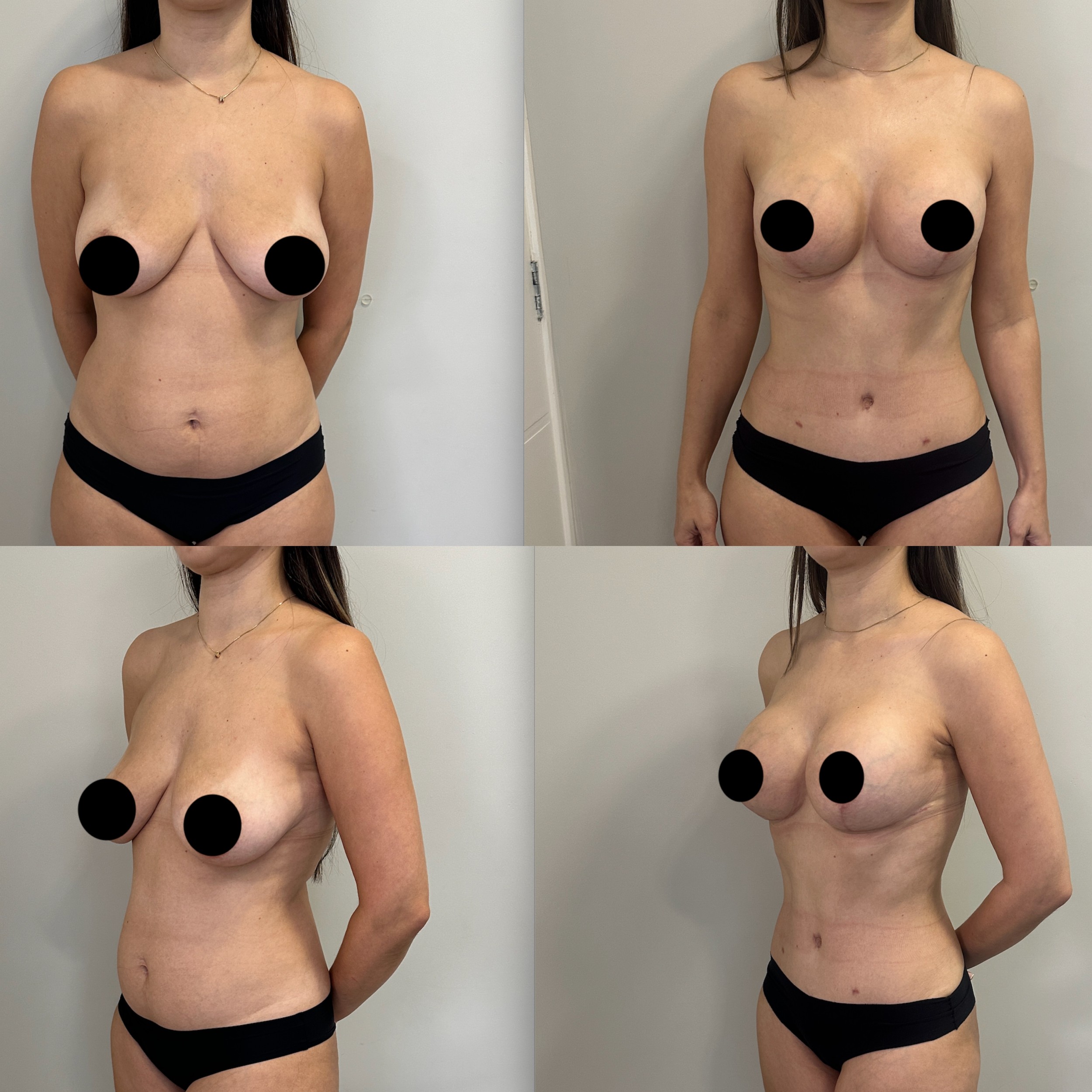
Breast Lift with Implants case – PUSH UP technique – 280 mL – Polyurethane – Mommy Makeover
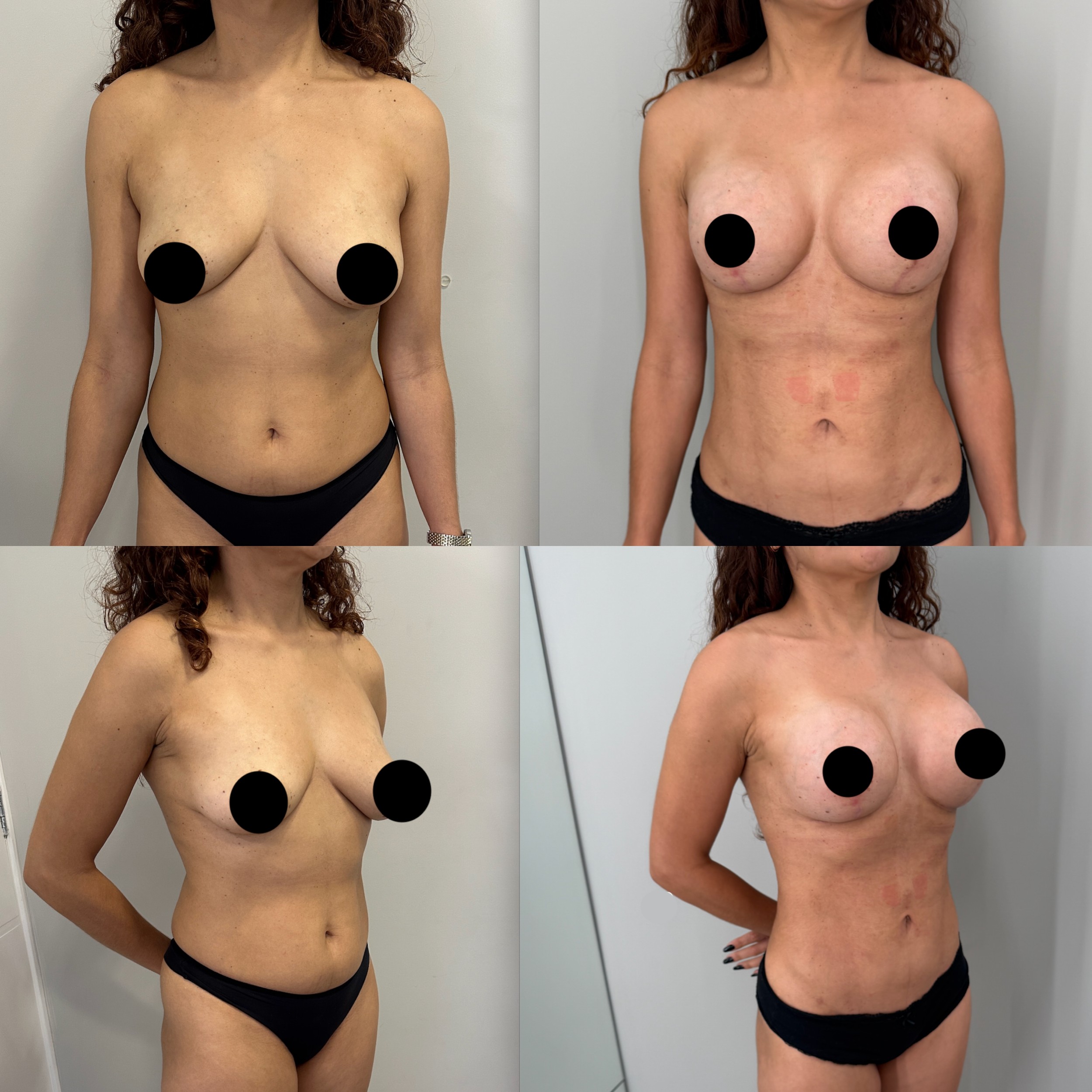
Breast Lift with Implants case – PUSH UP technique – 255 mL – Polyurethane
How is breast lift with implants surgery performed?
| Item | Information |
|---|---|
| Anesthesia | General anesthesia combined with local anesthesia. It can be performed under epidural anesthesia, but we prefer general anesthesia because it is safer and more comfortable |
| Duration | Around 3 to 4 hours |
| Size of the procedure | Small to medium-sized |
| Hospital stay | According to individual assessment — usually short |
| Skin technique | Short scar (L or mini-T scar) |
| Implant – individualized for each patient | Polyurethane-coated (high adhesion), with dimensions defined by the patient’s measurements / Textured implant |
| Plane – individualized for each patient | Push-Up technique (hybrid with a lower muscle sling) / Submuscular or Dual Plane |
Breast lift with implants is considered a safe surgery, with low complication rates when performed by a plastic surgeon holding the specialist title, in an appropriate hospital setting and with careful preoperative evaluation. A systematic review published in Plastic and Reconstructive Surgery analyzing single-stage breast lift with implants (Khavanin et al., 2014) documented complication and revision rates comparable to those of other aesthetic breast procedures.
What is recovery from breast lift with implants like?
Recovery is fast and progressive. Contrary to what many patients imagine, there is no period of immobility.
From the 1st day after surgery
- Walking — without any limitation, and in fact encouraged (early ambulation reduces thrombotic risk);
- Moving the arms normally, with care;
- Light everyday activities: using the computer, eating unassisted, showering;
- Independence for the basic household routine and light work such as computer work.
From 12-15 days
- Cleared for the gym — lower-body exercises (legs).
From 15-20 days
- Cleared to drive.
Further progression
- Gradual return to upper-body exercises, running and impact activities according to evaluation at the outpatient follow-up visits.
Throughout recovery, a surgical bra is worn and the specific instructions for each case are followed. Follow-up visits follow a predefined schedule, with direct monitoring by the surgeon.
Can breast lift with implants be combined with other surgeries?
Yes — and it is one of the surgeries that combines best with other procedures, as long as the patient is clinically fit for it. The most frequent combinations:
- Breast lift with implants + abdominoplasty — the classic post-pregnancy combination;
- Breast lift with implants + Liposuction + abdominoplasty — the “lipo + abdomen + breast” set is what is popularly called a Mommy Makeover;
- Breast augmentation with implants + high-definition liposuction
- Breast lift with implants + mini reverse abdominoplasty, in selected cases.
The decision to combine procedures is always individual and involves evaluating the total surgical time, the patient’s health status, comorbidities and the practice’s safety protocol. Large case series of aesthetic breast surgery with concomitant procedures show that the risk increases slightly with the number and extent of the associated procedures — which is why this indication is made with careful judgment and is never automatic.
See our complete protocol at Surgical Safety.
Safety first
Before any surgery, we individually assess factors such as biological age, comorbidities, thrombosis risk, nutritional status and preoperative laboratory tests. Our protocol includes a complete laboratory panel, thromboembolic risk stratification, preoperative optimization (including treatment of anemia when present) and selection of a hospital setting appropriate to the size of the procedure.
Read more at Surgical Safety and at Risks of plastic surgery: what you need to know.
Schedule your evaluation
Breast lift with implants is an individualized surgery: the technique, the plane, the type of scar and the implant are defined based on the physical exam and the goals of each patient.
Dr. Marco Longo — Plastic Surgeon CRM-SP 122.172 · RQE 58.398 Full Member of the Brazilian Society of Plastic Surgery (SBCP) Doctorate (PhD) from the University of São Paulo (USP) Fellowships: NYU and Memorial Sloan-Kettering Cancer Center (New York) Reviewer for the journal Aesthetic Plastic Surgery 15 years of experience in plastic surgery.
Alameda Min. Rocha Azevedo, 38 — CJ 1104 — Cerqueira César — Ciragan Office — São Paulo/SP WhatsApp: (11) 99892-5150 dr.marco.longo@gmail.com
[See clinical cases on Instagram]
Frequently asked questions about breast lift with implants
What is the difference between breast lift with implants and breast augmentation?
In breast augmentation, only the implant is placed, without skin removal — indicated for those who lack volume but do not have sagging. In breast lift with implants, in addition to the implant, the excess skin is removed and the breast is repositioned. If there is sagging and the implant is placed on its own, the breast tends to look like a “sagging breast with an implant” — which is why assessing the degree of ptosis is decisive.
Is it better to place the implant over or under the muscle?
It depends. There is no single answer. There are cases in which the plane in front of the muscle is clearly better, and cases in which muscle coverage is necessary. The choice depends on the thickness of the tissues, the degree of ptosis, the glandular volume, the body type and the level of physical activity. In the Push-Up technique, we use a hybrid approach precisely to take advantage of the best of both planes.
Is it safe to have a breast lift with implants combined with other surgeries?
It depends on the individual evaluation. The factors that weigh in are: the patient’s age and clinical condition, the presence of comorbidities, preoperative tests, the expected total surgical time and compliance with the practice’s safety protocol. In healthy patients, in good general health and with a complete preoperative evaluation, the combination is often possible and safe. In patients with risk factors, the procedure can be staged. Our evaluation protocol is detailed on the Surgical Safety page.
How long does breast lift with implants surgery take?
Around 3 to 4 hours, usually performed under general anesthesia combined with local anesthesia.
When can I drive and work out again?
Driving: from 15 to 20 days. Gym (lower body): from 15 days. Walking and light activities are allowed from the first day. Upper body, running and impact are cleared progressively, according to evaluation at the follow-up visits.
Does breast lift with implants leave a scar?
Yes — every breast lift leaves a scar, because skin has to be removed. The difference lies in the length: with the short scar techniques we use, the scar is “L” or “mini-T” shaped, considerably smaller than the classic “inverted T”. The final quality of the scar also depends on each patient’s genetics and individual healing, and it is monitored with a specific protocol in the postoperative period.
Why do you use polyurethane implants?
Because they have high adhesion to the tissues — the so-called “Velcro effect”. This adhesion makes the implant integrate with the muscle and the gland, forming a biological internal bra. In the Push-Up technique this is essential: it is what prevents the gland from slipping over the implant (pseudoptosis) and the implant from shifting over time. The long-term literature on polyurethane implants describes low rates of capsular contracture and implant rotation.
Does the breast sag again after breast lift with implants?
Every breast remains subject to the action of gravity, tissue aging, significant weight changes and new pregnancies. The technical goal of the Push-Up is precisely to delay this process, adding the support of the muscle sling to the adhesion of the polyurethane implant to the gland. Weight stability, proper use of the bra in the postoperative period and regular follow-up contribute to the durability of the result.
Will I be able to breastfeed after breast lift with implants?
The technique preserves the vascular and ductal pedicle of the areola, which, in most cases, maintains the possibility of breastfeeding. Even so, the ability to breastfeed cannot be guaranteed — not even in women who have never had surgery. If a pregnancy is planned in the short term, this should be discussed at the consultation, because pregnancy alters the result of the surgery.
Does the implant interfere with mammography or breast cancer screening?
Screening continues to be done normally. It is necessary to inform the imaging service of the presence of the implant, so that the appropriate views are taken (Eklund maneuvers). Ultrasound and magnetic resonance imaging also remain available. Follow-up with the breast specialist (mastologist) should be maintained on the usual schedule.
Do I need to replace the implant every 10 years?
No. There is no fixed expiration date that requires replacement. Replacement is indicated when there is a change in the implant, symptomatic capsular contracture, implant rupture (replacement is mandatory), a change in aesthetic preference or changes in the breast over time. Periodic follow-up with the plastic surgeon and imaging exams is what guides this decision.
When will I see the final result?
The breast goes through a settling process. The initial swelling decreases significantly in the first weeks, the shape is defined over the first months, and the scars continue to mature for up to 12 to 18 months. The scheduled follow-up visits monitor this evolution.
How is the implant size chosen?
By measurements, not by desire alone. The width of the breast base, the distance between the breasts, the thickness of the tissues, the height of the chest and the elasticity of the skin are assessed. Based on this, the volume range compatible with the anatomy is defined, within which the patient’s aesthetic preferences are accommodated. Choosing an implant larger than the breast can accommodate is one of the main causes of late complications.
Scientific references
- Khavanin N, Jordan SW, Rambachan A, Kim JYS. A systematic review of single-stage augmentation-mastopexy. Plast Reconstr Surg. 2014;134(5):922-931. doi:10.1097/PRS.0000000000000582
- Tebbetts JB. Dual plane breast augmentation: optimizing implant–soft-tissue relationships in a wide range of breast types. Plast Reconstr Surg. 2001;107(5):1255-1272. doi:10.1097/00006534-200104150-00027
- Yuan M, et al. Outcomes in subfascial versus subglandular planes in breast augmentation: a systematic review and meta-analysis. Aesthet Surg J. 2024;44(9):NP639-NP644. doi:10.1093/asj/sjae118
- Lonie S, et al. Inferolateral pectoralis sling technique for augmentation mastopexy. Aesthetic Plast Surg. 2024;48(21):4342-4350. doi:10.1007/s00266-024-03966-7
- Castel N, et al. Polyurethane-coated breast implants revisited: a 30-year follow-up. Arch Plast Surg. 2015;42(2):186-193. doi:10.5999/aps.2015.42.2.186
- Mele CM, Murante A, Auriemma E, et al. Augmentation mastopexy with polyurethane-coated implants in the prepectoral plane: a 24-month follow-up study. Aesthet Surg J Open Forum. 2026;8:ojag118. doi:10.1093/asjof/ojag118
Content for informational and educational purposes, in accordance with Federal Council of Medicine (CFM) Resolution No. 2.336/2023. It does not replace an in-person medical consultation. Results vary according to the individual characteristics of each patient and cannot be guaranteed.
Dr. Marco Longo — CRM 122.172 — RQE 58.398
Plastic Surgeon — PhD | USP
Specialist in High-Definition Body Contouring
Follow us on Instagram:
 https://www.instagram.com/drmarcolongo/
Visit the new YouTube channel :
 https://www.youtube.com/@drmarcolongo
Learn more about Dr Marco Longo – Plastic Surgeon
If you have any questions, please send them to: dr.marco.longo@gmail.com