
Plastic Surgery After Weight Loss: what to do when the body changes — and the skin doesn’t keep up
Significant weight loss — whether through bariatric surgery or the use of GLP-1 analogues such as Ozempic and Mounjaro — profoundly transforms health. But for many patients, this achievement comes with a new challenge: excess skin. Post-bariatric plastic surgery exists to complete this journey.
Losing weight is a victory — but the body keeps the marks of this transformation
In recent decades, Brazil has recorded a significant increase in the number of bariatric surgeries and, more recently, an accelerated expansion in the use of medications from the class of GLP-1 analogues — such as semaglutide (Ozempic, Wegovy) and tirzepatide (Mounjaro). These treatments have revolutionized the management of obesity and are capable of promoting weight losses that previously could only be achieved with surgical procedures.
The benefits are real and extensive: improved glycemic control, lower blood pressure, decreased systemic inflammation associated with obesity and reduced cardiovascular risk. Losing weight, especially when it comes to major weight loss, is a genuine health milestone.
But the body keeps the memory of every kilogram it carried. The skin, which spent years being stretched by the accumulation of fat, loses its elastic capacity. When the internal volume decreases rapidly and significantly, this skin does not retract — it is left over.
What happens to the body after major weight loss?
When a patient loses between 30 and 60 kg — or more — in a relatively short period, the result goes beyond the scale. The body contour changes profoundly, but not always in a uniform or aesthetically satisfying way.
The most common effects are:
- Excess skin on the abdomen, which can form folds or an “abdominal apron”
- Breast ptosis (sagging breasts), with loss of volume and support
- Sagging of the arms (inner region), with hanging skin
- Sagging of the thighs, especially on the inner side
- Redundant skin on the back and flanks
In addition to the aesthetic impact, this excess skin can cause real functional problems: irritation and dermatitis in the folds, difficulty with hygiene, physical discomfort during activities and a significant impact on self-esteem and quality of life — even after the whole achievement of losing weight.
Post-bariatric plastic surgery: what is it and who is it for?
Post-bariatric plastic surgery — also called body contouring surgery after weight loss — is the set of procedures indicated to correct excess skin and reshape the body of patients who have reached or are close to their target weight after major weight loss.
It applies to:
- Post-bariatric surgery patients (gastric bypass, sleeve, among others)
- Patients with major weight loss from GLP-1 analogues (semaglutide, tirzepatide)
- Patients with significant weight loss by other methods (clinical treatment, diet and exercise)
The fundamental criterion for the surgical indication is not the weight-loss method, but rather weight stability — the patient’s weight must have been stable for at least 6 to 12 months before any plastic procedure. This ensures that the result of the surgery is long-lasting.
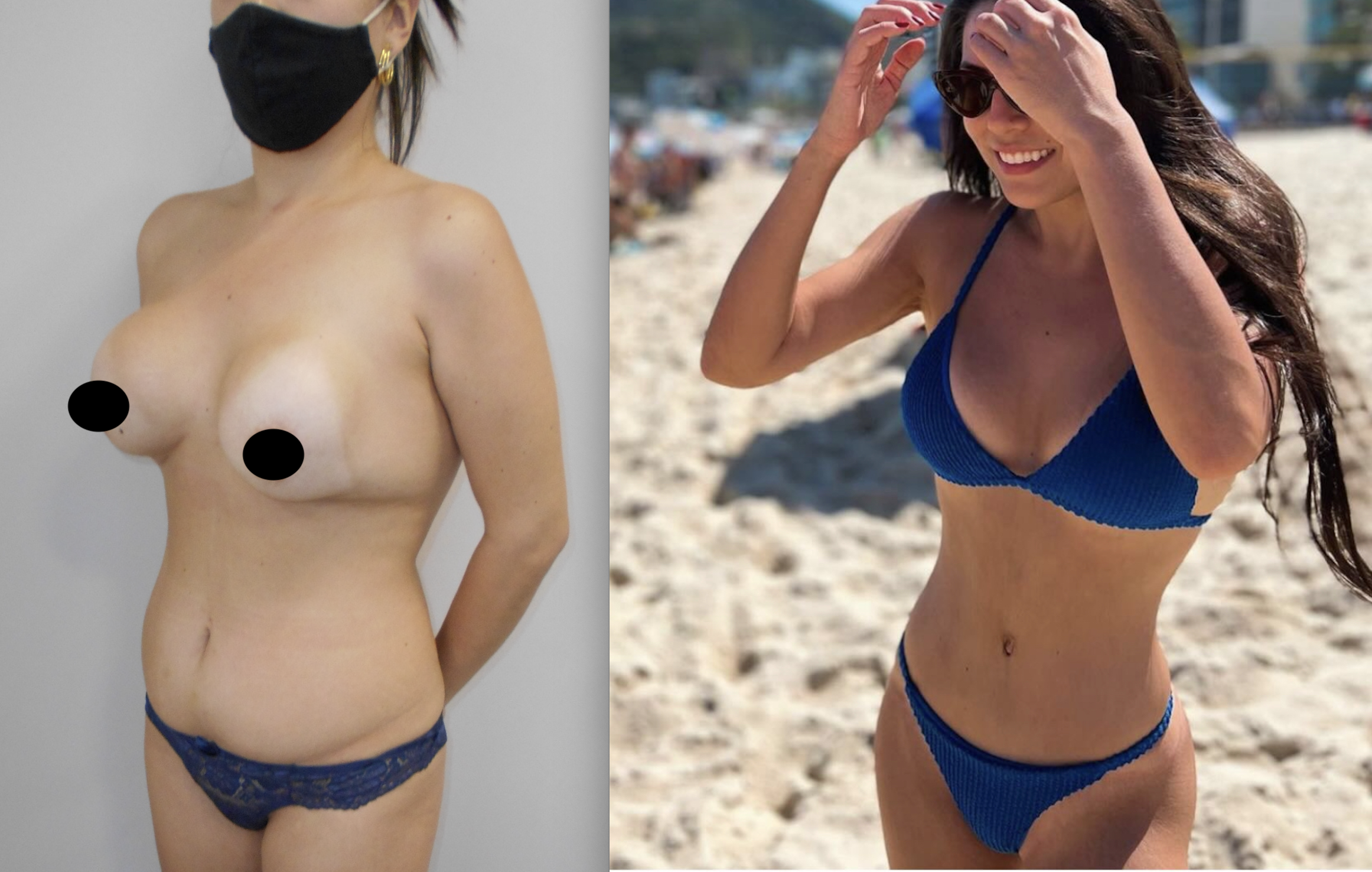
Mommy Makeover case – Lipo + Abdomen + Breast with Implant – in a post-bariatric patient
The main post-bariatric body contouring surgeries
Abdominoplasty — the most requested
Abdominoplasty (tummy tuck) is, in the vast majority of cases, the central procedure of post-bariatric surgery. It removes excess skin and fat from the abdomen, corrects diastasis (separation of the abdominal muscles — very common after major weight fluctuations) and repositions the navel.
In patients with major weight loss, the technique may be more extensive than in conventional aesthetic abdominoplasty — frequently combined with an anchor dermolipectomy or with circumferential contouring (body lift) procedures, which also address the flanks and the gluteal region.
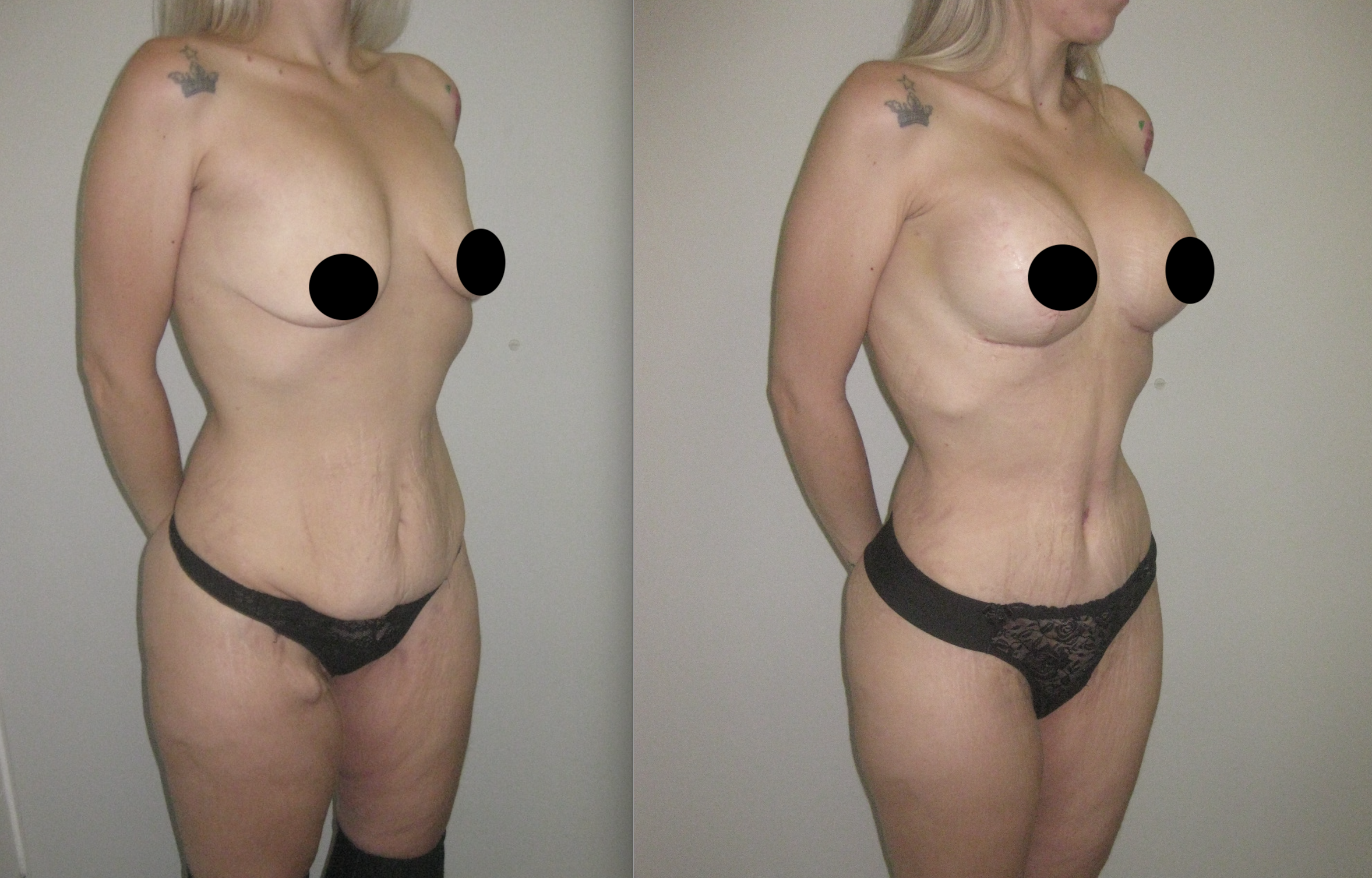
Mommy Makeover case – Lipo + Abdomen + Breast with Implant – in a post-bariatric patient
Mammoplasty — reduction, lift and volume reconstruction
Weight loss profoundly affects the breasts: the fatty volume that made them up is reduced, but the skin remains. The result is a ptotic (sagging) breast, with little internal volume and excess skin.
Depending on the case, treatment may involve:
- Mastopexy (breast lift) to reposition the tissue and remove the excess skin
- Breast augmentation with implants to restore the lost volume
- Breast reduction when there is excess residual tissue
Brachioplasty — plastic surgery of the arms
Brachioplasty removes excess skin from the inner side of the arms — one of the regions most affected by rapid weight loss. It results in firmer, more defined arms, with the scar placed on the inner side of the limb, where it is less visible.
Cruroplasty — plastic surgery of the thighs
Cruroplasty (or thigh dermolipectomy) addresses sagging of the inner thighs, an area where excess skin is frequent after major weight loss and which often causes significant discomfort — even when walking. The scar is placed in the groin or along the inner side of the thigh, depending on the extent required.
Liposculpture (HD Lipo)
In many cases, even after weight loss, there are localized fat deposits that resist slimming down. High-definition liposuction can be used — alone or in combination with other procedures — to refine the contour, improve the transition between regions and accentuate muscle definition.
What sets post-bariatric surgery apart from conventional aesthetic plastic surgery?
Technically, the procedures are similar — but not identical. And this difference matters.
The patient who has undergone major weight loss presents specific characteristics that require important technical adaptations:
1. Thinner skin with less elasticity The skin of post-bariatric patients is generally thinner than that of patients with no history of obesity. This directly influences the planning of the incisions, the tension applied to the closure and the fixation techniques used to ensure the durability of the result.
2. Greater extent of the resections The volume of skin to be removed is usually significantly greater than in conventional aesthetic surgeries. This may require longer incisions and combined approaches (more than one region in the same surgical procedure or in planned stages).
3. Nutrition and healing Post-bariatric patients frequently have nutritional deficiencies — in protein, iron, zinc, B-complex vitamins and vitamin C — that can directly compromise healing. The preoperative evaluation should include complete lab work and, when necessary, appropriate supplementation before surgery.
4. Staged planning In cases with excess skin in multiple regions, it is rarely possible — or safe — to resolve everything in a single operation. Careful planning of the surgical stages, with adequate recovery intervals, is essential for the safety and quality of the results.
For all these reasons, choosing a plastic surgeon with specific experience in post-bariatric surgery makes a real difference in the final result — both in aesthetic terms and in terms of safety.
A new patient profile: weight loss with GLP-1
With the popularization of GLP-1 analogues, especially semaglutide and tirzepatide, a new patient profile has arrived at plastic surgery offices: people who lose a significant amount of weight without going through the bariatric surgical process, but who face the same challenges with excess skin.
These patients generally have a clinical profile different from the classic post-bariatric patient — often with a lower risk of nutritional deficiencies and without a history of previous abdominal surgery. But the body contouring challenge is analogous, and the indicated procedures are essentially the same.
The difference lies in the details of the preoperative evaluation and in individualized planning — which must consider whether the patient is still taking the medication, whether the weight is truly stable and what the prognosis for long-term weight maintenance is.
When can I have plastic surgery after losing weight?
The most important answer is: when your weight is stable.
Operating while the weight is still dropping compromises the result. As the patient continues to lose weight after surgery, new excess skin may appear, impairing the contour achieved.
The general criteria for evaluation include:
- Stable weight for at least 6 to 12 months
- BMI within a range that allows adequate surgical safety
- Normalized lab tests (especially for post-bariatric patients)
- Absence of decompensated comorbidities
- Individualized evaluation with the plastic surgeon
Post-bariatric surgery and self-esteem: the final chapter of a transformation
Losing weight is an achievement that requires determination, discipline and, often, the courage to seek help. Post-bariatric plastic surgery is not a “superfluous” step in this journey — for many patients, it is what allows the inner transformation to show completely in the mirror.
Patients who have undergone body contouring surgery consistently report a marked improvement in self-esteem, in their willingness to engage in physical and social activities, and in the feeling that the body has finally “caught up with” the transformation that had already happened inside.
If you have undergone bariatric surgery or are being treated with GLP-1 analogues and want to understand which procedures make sense for your case — and what the right time is to have them — the path begins with a detailed consultation with a specialized plastic surgeon.
Dr. Marco Longo is a plastic surgeon specializing in body surgery, a member of the Brazilian Society of Plastic Surgery (SBCP), the Brazilian Association of Plastic Surgeons (BAPS) and the American Society of Plastic Surgeons (ASPS), with a doctorate from the University of São Paulo School of Medicine (FMUSP). He sees patients in São Paulo.
Safety first. Before any surgery, we individually assess factors such as biological age, comorbidities and thrombosis risk, following protocols based on scientific evidence. Learn how we assess safety in each procedure →
Dr. Marco Longo — CRM 122.172 — RQE 58.398
Plastic Surgeon — PhD | USP
Specialist in High-Definition Body Contouring
Follow us on Instagram:
 https://www.instagram.com/drmarcolongo/
Visit the new YouTube channel:
 https://www.youtube.com/@drmarcolongo
Learn more about Dr Marco Longo – Plastic Surgeon
If you have any questions, please send them to: dr.marco.longo@gmail.com